The Mystery of the Megaliths
 No place has generated so much speculation and wild theories as the standing stones of Stonehenge. After driving for miles through the rolling hills and plains of the English countryside the sight of this unusual structure makes people gasp. A walk around it only provokes more strange feelings. There’s a sense that this is something very important. It taunts us with its mystery. For over 5000 years it has stood silent vigil over the earth. It has been excavated, x-rayed, measured, and surveyed. Yet despite all that has been learned about its age and construction, its purpose still remains one of the great mysteries of the world.
Construction
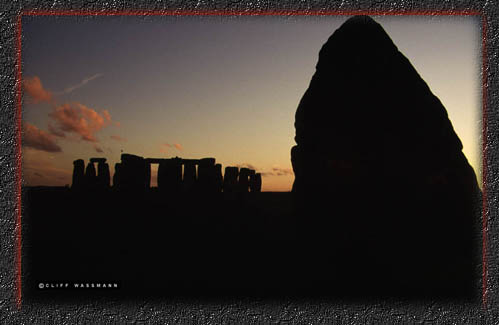
Around 3500 BC the semi-nomadic peoples that populated the Salisbury Plain began to build the monument now known as Stonehenge. The original construction was a circular ditch and mound with 56 holes forming a ring around its perimeter. The first stone to be placed at the site was the Heel Stone. It was erected outside of a single entrance to the site. 200 years later 80 blocks of bluestone was transported from a quarry almost 200 miles away in the Prescelly Mountains. It is surmized that these blocks were transported by way of rafts along the Welsh coast and up local rivers, finally to be dragged overland to the site. These stones were erected forming two concentric circles.
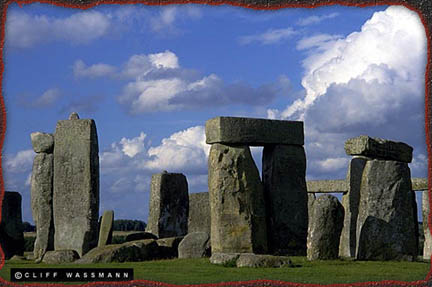
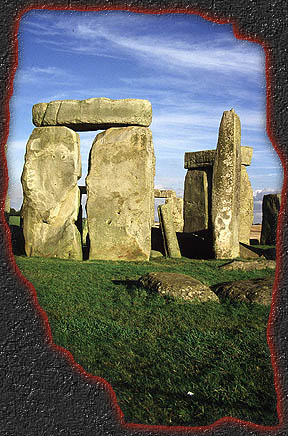 At some point this construction was dismantled and work began on the final phase of the site. The bluestones were moved within the circle and the gigantic stones that give Stonehenge its distinctive look were installed. Some of these massive stones weigh as much as 26 tons! It remains a mystery how such huge stones could have been moved from the quarry at north Wiltshire by a supposedly primitive people.
As much of a mystery is how the construction itself was accomplished. Carefully carved lintels were placed on top of pairs of upright stone blocks, held in place by the use of ball and socket joints. These constructions have become known as “trilithons”. The final element to be added was the alter block, a large block of green sandstone from South Wales that was placed in front of one of the trilithons. (right) Close up of stonework on top of trilithon Over 1500 years had passed since the beginning of construction.. Each generation carefully tended to the monuments, increasing its size as technology to move and finish the large blocks improved. It is almost inconceivable for us, in this age were nothing lasts more than a few decades at best, to image a people maintaining a monument for almost 2 millennia.
So the fundamental question that needs to be asked about Stonehenge is not how it was built, but why…
Stonehenge’s Purpose
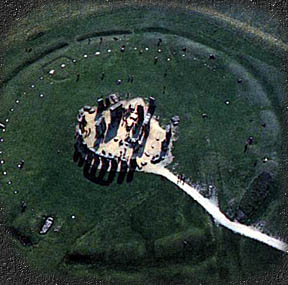 In the 1960’s astronomer Gerald Hawkins used a computer to provide the first concrete evidence that Stonehenge was used as a device for observing the heavens. He found that the placement of key stones lined up precisely with certain events such as the Solstices and Equinoxes. He claimed that Stonehenge could even be used as a type of computer to predict eclipses and track heavenly bodies across the sky. The numerous alignments are clearly no accident, but whether this was the monuments true purpose, however, is still far from being agreed on. The monument seems too grand to be a simple calendar and many of the alignments touted would not even be visible due to the stone’s great height.
There are many stone circles and standing stones in the British countryside. It is likely that they all had a similar purpose and as with other ancient sites it is not unusual to find alignments with major astronomical events. But Stonehenge is unique among all the other sites in England. Its sophistication goes beyond the simple stone circles found in other areas.
It looms over the landscape, taunting us with its mystery. One viewing this powerful structure gets the distinct impression that they are in the presence of something very important. Something with a purpose that perhaps has still, after all these centuries, not been utilized. For over 5000 years it has stood silent vigil over the earth. What will it do when it –